
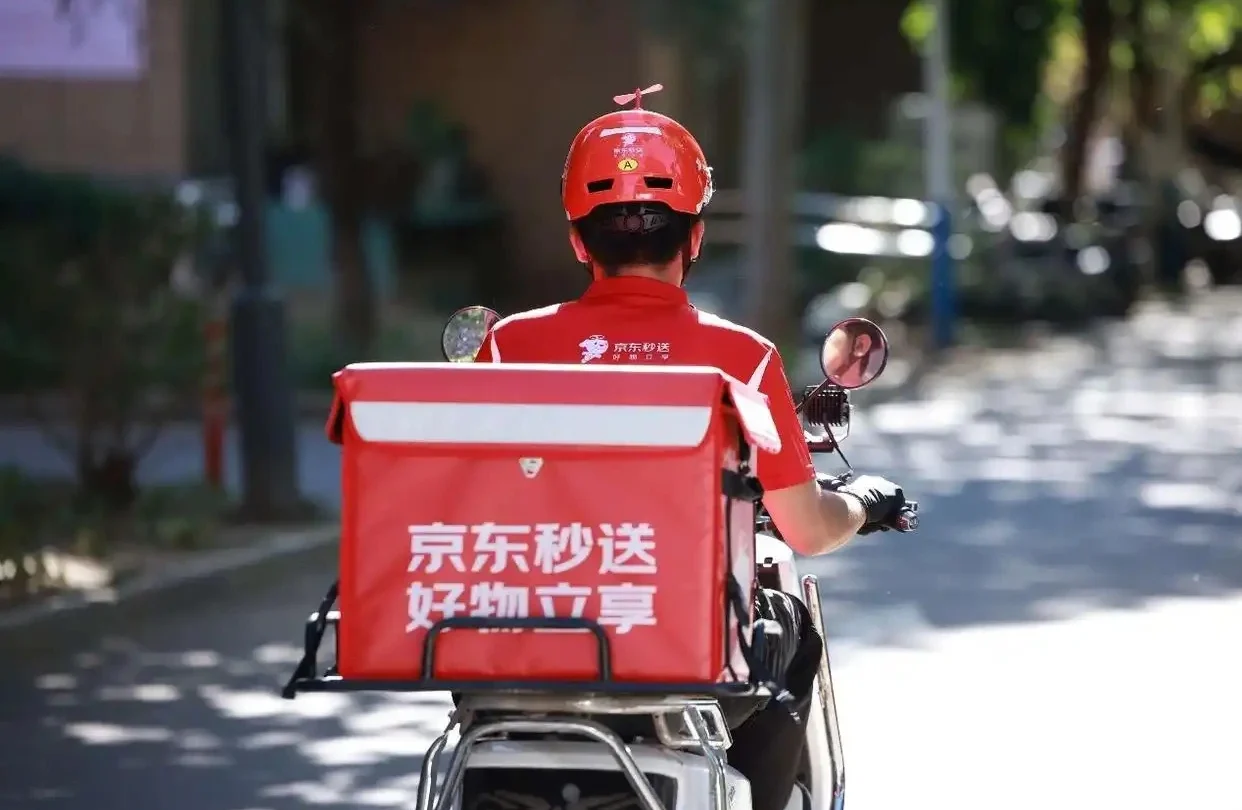
JD.com has introduced an AI-enabled helmet for food-delivery couriers, joining Alibaba and Meituan in placing connected hardware directly into rider workflows. The launch turns protective equipment into an operating interface for orders, navigation, customer communication and collection checks, extending platform software from the smartphone to the rider’s head.
The device combines an AI voice assistant with a camera capable of interpreting the surrounding environment. JD.com says the hands-free design is intended to reduce distraction when rain, wet hands or poor visibility make a phone difficult to use. Couriers can manage new orders, contact customers and complete essential actions through voice commands while travelling.
Navigation goes beyond conventional online maps. The helmet provides turn-by-turn voice prompts built from routes used by experienced riders, aiming to help newer workers locate entrances and destinations in unfamiliar compounds. The commercial proposition is lower search time and fewer delays, although JD.com has not disclosed measured productivity results from field use.
The system can also read delivery instructions aloud, including contactless drop-off requests, reducing the risk that a rider misses a note while moving between orders. At restaurants, the camera can assist collection-quality checks and potentially flag hygiene concerns. Those functions make the helmet both a safety device and a mobile quality-control point.
JD.com plans to distribute the first units free to its full-time couriers and later expand availability to all food-delivery personnel on the platform. The announcement did not specify how many helmets are in the first batch, when full coverage is expected, what the hardware costs or whether non-full-time riders will eventually face any charge.
Rivals provide the scale benchmark. By June 2025, Meituan had deployed more than one million smart helmets with voice communication, fall detection and automated emergency response. Alibaba’s delivery operation, formerly Ele.me and now Taobao Shangou, introduced a voice-enabled smart helmet in late 2022. JD.com is therefore entering an established hardware race rather than creating a new category.
The addressable workforce is large: China had more than ten million food-delivery riders by early 2025. Platforms operate under intense competition while couriers work against tight deadlines and difficult weather, making safety and route efficiency commercially important. At the same time, camera-based workplace tools concentrate more operational data in the platform and require clear rules for access, retention and accountability.
The next test is deployment evidence. JD.com must show that the helmet works reliably in rain and traffic, improves navigation without adding cognitive load, identifies genuine quality problems accurately and reaches riders at useful scale. Until batch size, performance data and rollout timing are disclosed, the product is a strategically relevant launch, not yet proof of platform-wide transformation.