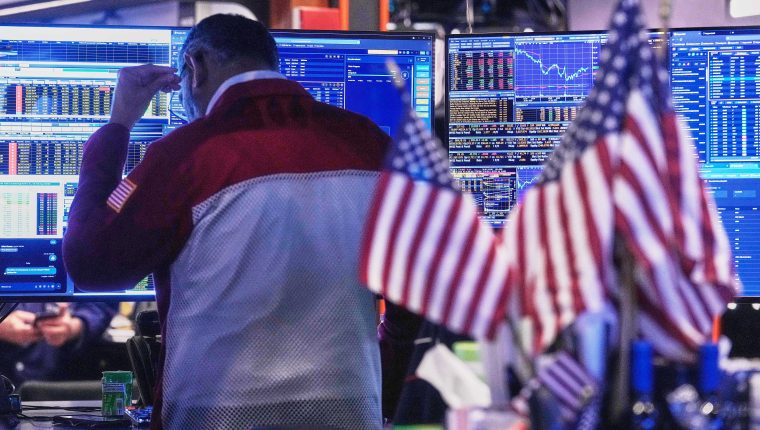

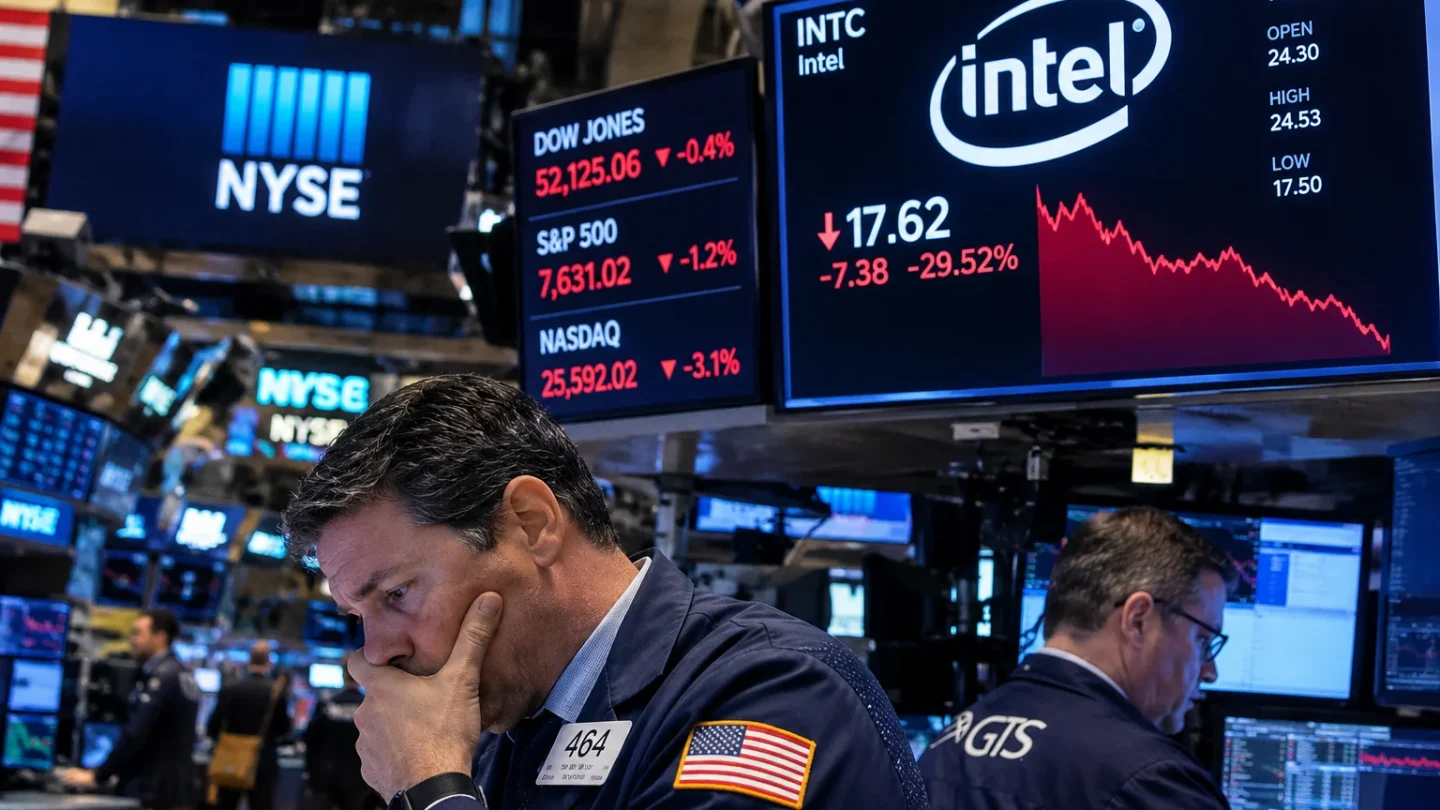
United States stocks ended sharply lower on Friday as investors reassessed the cost and timing of the artificial-intelligence investment cycle. The S&P 500 fell 1.8% to 7,580.07, its worst decline since June. The technology-heavy Nasdaq Composite dropped 2.9% to 25,437, while the Dow Jones Industrial Average lost 572.25 points, or 1.1%, to close at 51,770.31.
The session’s most severe company move came from Intel, whose shares sank almost 29% after a profit forecast fell short of expectations. It was the chipmaker’s worst one-day performance since 1974. The fall showed how quickly a market willing to reward an AI narrative can reverse when earnings guidance does not support the capital, execution and margin assumptions embedded in a valuation.
Amazon added to the pressure after its results highlighted another increase in spending for data centers and AI capacity. Demand for cloud computing can remain strong while shareholders still question the period required for depreciation-heavy infrastructure to generate sufficient revenue and cash flow. The market reaction was therefore not a rejection of AI demand, but a repricing of financing intensity, margins and payback time.
The selloff spread beyond a single stock. Nvidia lost 4.2%, and other technology and crypto-linked shares weakened, increasing the Nasdaq’s decline. Concentrated index leadership magnifies that effect: when the largest companies fall together, their weights can pull broad benchmarks lower even if many smaller businesses have little direct exposure to the same spending cycle.
Cross-asset moves signaled risk reduction rather than a simple rotation between equity sectors. Treasury yields fell as buyers moved toward government debt, while oil prices rose. Lower yields can eventually support long-duration technology valuations, but during a stressed session they may first reflect concern about growth, profitability or geopolitical risk rather than confidence in easier financial conditions.
The weekly results were less dramatic than Friday’s close. The S&P 500 lost 0.6% for the week, the Dow 0.9% and the Nasdaq 2%, while the Russell 2000 gained 1.3%. That divergence suggests some movement away from megacap technology toward smaller companies, but one week is insufficient to establish a durable broadening of market leadership.
Despite the setback, the year-to-date picture remained positive: the S&P 500 was up 10.7%, the Dow 7.7%, the Nasdaq 9.4% and the Russell 2000 13.3%. Those gains matter because they leave valuations and expectations elevated. A sharp daily fall can be both a correction within an advance and a warning that investors now demand more evidence for expensive investment programs.
The next test is whether earnings, cloud bookings, AI utilization and free cash flow begin to validate the capital expenditures already announced. Investors will also watch credit conditions, Treasury yields and the breadth of selling. Friday’s close documents a meaningful repricing, not proof that the AI cycle has failed or that a bear market has begun.