
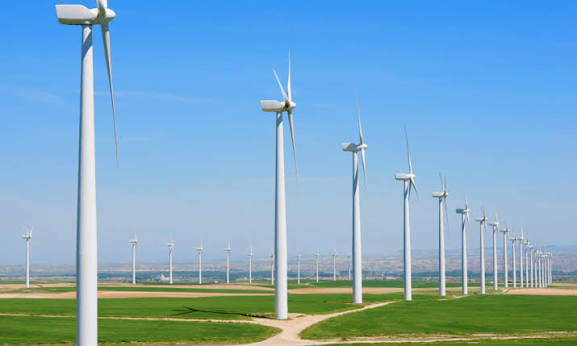
Seriti Green has placed the first 25 turbines of the Ummbila Emoyeni Wind Farm into commercial operation in Mpumalanga, South Africa’s coal heartland. The operating capacity is 155 MW and forms the first phase of a renewable-energy programme planned to reach 900 MW across the province.
The location gives the project strategic weight. The wind complex sits near the Secunda coal-to-liquids operation and three Eskom power stations, while Seriti’s coal mines are anchor buyers of its electricity. Power-purchase agreements are in place with Energy Exchange and NOA, while Etana Energy initialled a PPA at the launch ceremony, expanding the prospective customer base beyond the group’s own mining assets.
Seriti says it has invested R15 billion in the wind project so far. Standard Bank and Rand Merchant Bank have taken equity, and a new agreement with Standard Bank adds a further R10 billion, bringing the stated investment commitment to R25 billion. Those figures fund a platform under construction, not 900 MW already in service.
Equipment and grid infrastructure are advancing in parallel. Goldwind has installed 48 turbines at the site, of which 25 are operating. Stefanutti Stocks and Tractionel delivered the R1.2 billion main transmission substation in 17 months and transferred it to the National Transmission Company South Africa, providing the connection required for the wind farms.
Seriti Green CEO Peter Venn said a further 600 MW of wind development is planned across the road from the operating phase. Together, Ummbila Emoyeni and the proposed Phefumula Emoyeni development would comprise 187 turbines. The company estimates that its total renewable investment in Mpumalanga could ultimately reach R40 billion.
The portfolio is intended to extend beyond wind. Plans are advancing for a solar photovoltaic project on land rehabilitated by Middelburg Mine Services, in partnership with Eskom Green near the Duvha power station, while battery-energy-storage options remain under investigation. Solar and storage should therefore be treated as development work rather than commissioned capacity.
Seriti links the programme to South Africa’s Just Energy Transition while maintaining coal production, including at the Naudesbank Colliery, which has a stated 20-year mine life. About 2,100 employees have contributed to the renewable project to date, including workers from coal. Management argues that transferable industrial skills could support 10,000 renewable-construction jobs over the next decade, but that remains an ambition requiring a continuous project pipeline.
The commercial test now moves from inauguration to execution. Seriti must bring the remaining turbines online, secure demand for each new phase, complete the additional wind, solar and storage investments and demonstrate that grid infrastructure can absorb the output. The 155 MW milestone is concrete; the 900 MW platform and R40 billion scale remain the next set of commitments to deliver.