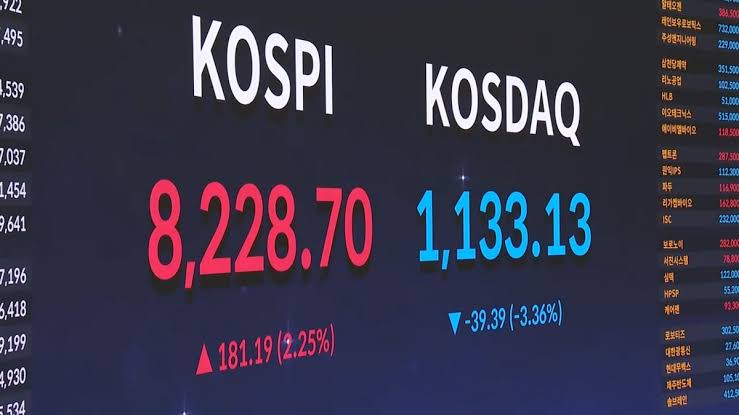
South Korean equities were positioned to end a seven-week losing streak as the benchmark Kospi gained 55.55 points, or 0.82%, to 6,868.89 at 01:32 GMT on Friday. The index had risen as much as 2.9% earlier before investors trimmed risk ahead of a Monday public holiday, making the figures an intraday reading rather than a final close.
The advance marked a fifth consecutive rising session and lifted the index 9.4% over that span. It followed a decline of nearly 31% across the preceding seven weeks. Market stress also receded: South Korea’s volatility index stood at 56, well below its record level of 98 in late June, though still high enough to signal substantial uncertainty.
Semiconductor enthusiasm tied to artificial intelligence was the main catalyst, reinforced by gains in U.S. technology stocks and a record close for the S&P 500 on Thursday. Softer-than-expected U.S. producer inflation also strengthened expectations that the Federal Reserve would leave rates unchanged in September, improving the backdrop for growth-sensitive assets.
Performance inside the technology complex was not uniform. SK Hynix rose 3.01%, while Samsung Electronics slipped 0.37% after gaining more than 2% earlier, and LG Energy Solution fell 1.37%. The split shows that the recovery favored specific AI and memory-chip exposures rather than lifting every large technology name equally.
Automakers added a second pillar to the rally. Hyundai Motor gained 5.73% and Kia advanced 1.97%; POSCO Holdings rose 1.08%. Samsung BioLogics moved in the opposite direction, falling 1.09%, underscoring that the session combined strong sector leaders with continuing weakness elsewhere.
Breadth was only modestly positive, with 453 of 903 traded shares advancing and 420 declining. Foreign investors were net buyers of 780.2 billion won, equivalent to about $550.81 million. Those flows matter because they broadened support beyond domestic momentum traders, but a single session does not establish a lasting allocation shift.
The won strengthened 0.16% to 1,416.3 per dollar from 1,418.6, while sovereign bonds also attracted demand. September three-year bond futures added 0.04 point to 103.33; the liquid three-year yield fell 0.6 basis points to 3.774%, and the benchmark 10-year yield declined 1.1 basis points to 4.282%.
The recovery therefore combined AI optimism, foreign equity inflows, currency appreciation and easing yields. Its durability still depends on final weekly closing levels, semiconductor earnings, U.S. rate expectations and the return of trading after the holiday. Ending a seven-week losing streak would mark stabilization, not erase the preceding 31% fall.