
Middle Eastern buyers are approaching Canadian liquefied-natural-gas developers as the conflict involving Iran and disruption around the Strait of Hormuz force even producers in the Gulf to examine supply routes outside their own region. Ratnesh Bedi, president of Singapore-based Pacific Energy, said his company is receiving inquiries almost every week from parties seeking capacity or alternative supply for customers. The companies were not identified, and no new cargo or investment agreement was announced.
The immediate commercial constraint is that Pacific Energy’s Woodfibre LNG project does not have unsold production. Its planned capacity of 2.1 million tonnes a year is fully contracted to BP. Interest from other buyers therefore signals demand for future portfolio relationships, equity positions or supply from additional Canadian projects; it does not make Woodfibre volumes available to the spot market.
Pacific Energy owns 70% of Woodfibre, which is under construction near Squamish on Canada’s Pacific coast. Bedi said the project is targeting December 2027 for its first export cargo. Until construction, commissioning and the first shipment are completed, Woodfibre remains a development project with contracted output rather than an operating source of emergency LNG.
Canada’s federal government has separately confirmed strong Middle Eastern interest in both equity investment and long-term offtake. The approaches reflect a change in risk management after shipping through the Strait of Hormuz was disrupted. Buyers that once treated Gulf supply as a foundation of their portfolios are now evaluating contractual access to production that does not cross a narrow geopolitical chokepoint.
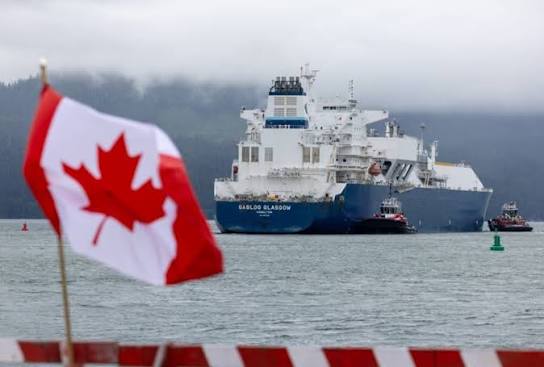
Western Canada offers a Pacific route that also shortens voyages to Asian markets compared with exports from the US Gulf Coast. That geography matters for Northeast Asian customers and for Middle Eastern suppliers looking to cover obligations to their own clients. It does not remove every transport or construction risk, but it separates Canadian west-coast cargoes from Hormuz and other straits central to Gulf exports.
Other transactions show that the interest extends beyond Woodfibre. Germany’s SEFE and Uniper have signed long-term offtake agreements with the proposed Ksi Lisims LNG project. MidOcean Energy, backed by EIG and Saudi Aramco, acquired an interest in Petronas’ stake in LNG Canada. Those deals combine physical supply access and equity exposure, the two forms of participation Canadian officials say Middle Eastern groups are now exploring.
The investment case still carries a cost and timing penalty. Western Canada has low natural-gas prices, but development can be comparatively expensive and regulatory reviews can add years. Prime Minister Mark Carney’s government is seeking faster permitting for energy infrastructure, although policy support cannot substitute for engineering completion, financing discipline or compliance with existing approvals. Bedi said Woodfibre’s owners are focused on finishing the current project and are not yet planning an expansion.
The next milestones are therefore contractual and operational rather than rhetorical. Middle Eastern inquiries would need to become named equity commitments or offtake contracts at projects with unallocated volumes, while Woodfibre must reach its December 2027 export target under the BP agreement. Until then, Canada’s value as a Hormuz hedge is strategically visible, but its ability to provide incremental emergency supply depends on projects and capacity beyond Woodfibre’s already-sold first phase.