
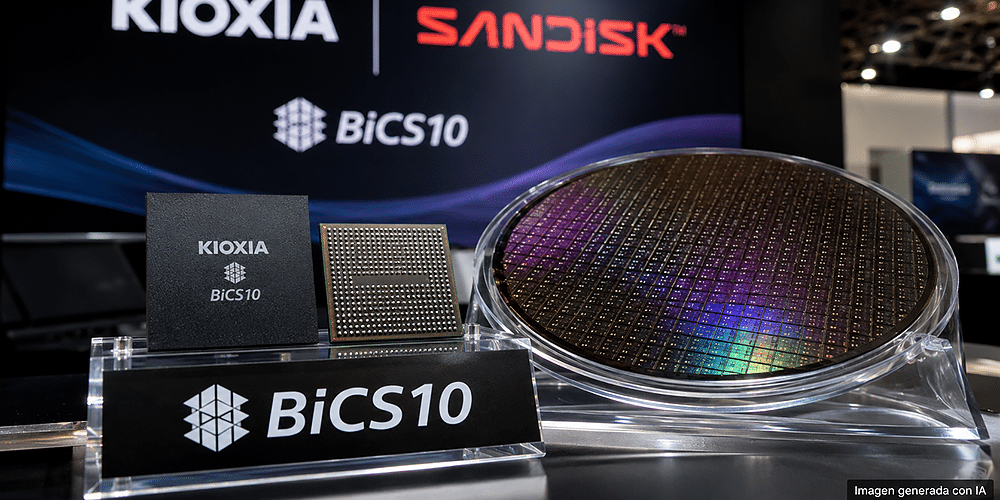
Kioxia and Sandisk announced anticipated investments of more than $31 billion, approximately ¥5 trillion, in Japan through 2032. The plan is explicitly contingent on government support, so the headline amount represents intended multi-year spending rather than capital already deployed.
The program will support continued infrastructure and technology buildout at Kioxia’s Yokkaichi and Kitakami plants and related facilities. The companies did not disclose annual spending, new wafer capacity, production start dates or how the total will be allocated between sites and technologies.
The partners jointly develop and manufacture flash-memory wafers through a relationship spanning more than 25 years. This is an expansion of an established manufacturing alliance, not a new merger or a change in ownership of the two companies.
In January, Kioxia and Sandisk extended their joint-venture framework at Yokkaichi through December 2034. The longer contractual horizon supports coordination of equipment and process investments whose planning, installation and qualification cycles can run for several years.
The companies say they have already invested more than $50 billion, approximately ¥9 trillion, in Japan over the previous 25 years. The new announcement covers expected spending through 2032, but it does not provide a year-by-year bridge between historical investment and the future program.
Their stated objective is meaningful multi-year bit growth and stable supply of advanced three-dimensional NAND flash memory. Bit growth can come from both greater wafer output and higher storage density per chip, so it cannot be translated directly into a disclosed number of factories, wafers or devices.
Artificial intelligence increases demand not only for processors but also for storage used in datasets, model checkpoints, content and data-center operations. Kioxia and Sandisk are positioning NAND as part of that infrastructure, although the announcement contains no customer contracts, revenue forecast or guaranteed demand volume.
The plan aligns with Japan’s policy of supporting strategic semiconductor manufacturing and is presented as U.S.-Japan industrial cooperation. Its final scale and timing still depend on public support, market demand, construction, equipment availability and the memory cycle; announcing the program does not ensure that every planned dollar will be spent.