

India and the Southern African Customs Union are moving toward a formal restart of negotiations for a preferential trade agreement. An Indian official said the parties may sign terms of reference on August 12. That document would authorize and structure talks; it would not itself create a trade agreement, lower a tariff or guarantee that negotiations will conclude.
SACU brings together South Africa, Botswana, Namibia, Eswatini and Lesotho under a common customs framework. India would therefore be negotiating with a bloc whose members have very different economic scale, export profiles and interests. Product coverage, tariff schedules, rules of origin, safeguards and implementation periods have not yet been published.
The distinction between a negotiating mandate and a finished pact is especially important because the parties tried before. India and SACU held talks in 2008, but the proposed arrangement stalled over market-access differences. A new terms-of-reference document can reopen the process without resolving the questions that blocked the earlier attempt.
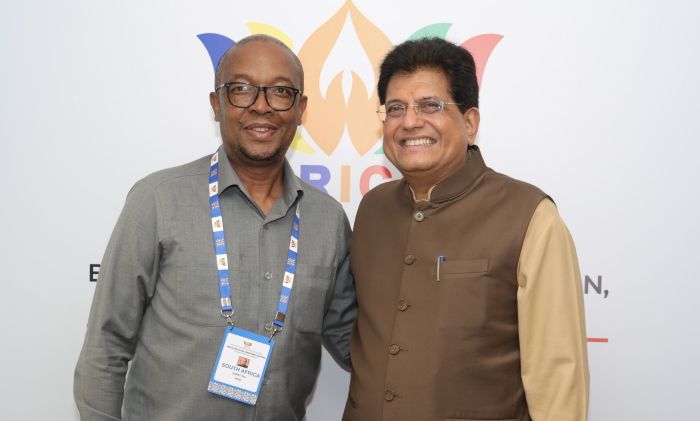
The latest political signal followed a meeting between Indian Commerce and Industry Minister Piyush Goyal and South African Trade, Industry and Competition Minister Parks Tau on the sidelines of a BRICS ministerial gathering. Goyal said they discussed the India–SACU process and cooperation in critical minerals, pharmaceuticals and manufacturing, three sectors that could shape requests and concessions.
South Africa is India’s largest trading partner inside SACU, but two-way trade fell 13.55% to $15.56 billion in the 2025–26 fiscal year from $18 billion a year earlier. India exported $7 billion and imported $8.56 billion, leaving a $1.55 billion deficit. Indian sales include vehicles, pharmaceuticals, engineering goods, footwear, chemicals, textiles and rice, while purchases include gold, coal, copper ores, phosphoric acid and manganese.
Botswana presents a smaller but growing corridor. Bilateral trade rose 21.26% to $614 million, with Indian exports of $167.53 million and imports of $446.47 million, producing a $278.94 million Indian deficit. Rough diamonds dominate Botswana’s exports to India, while Indian companies sell pharmaceuticals, machinery, electrical equipment, iron and steel alongside processed precious-stone activity.
Trade with Namibia increased 4.32% to $593 million, including $349 million in Indian exports and $244 million in imports, giving India a $105.24 million surplus. Namibia’s uranium, diamonds, copper, phosphates and other minerals create resource-sector interests, while Indian capabilities in information technology, pharmaceuticals, renewable energy and small-business development broaden the possible agenda beyond raw materials.
The immediate test is whether the terms are actually signed and disclose a workable scope. Negotiators would then need to bridge market-access differences and produce product lists before governments can approve any pact. Until those stages are completed, August 12 is a procedural milestone rather than a new tariff regime; the data show commercial potential, but not an agreed distribution of benefits among India and all five SACU economies.