
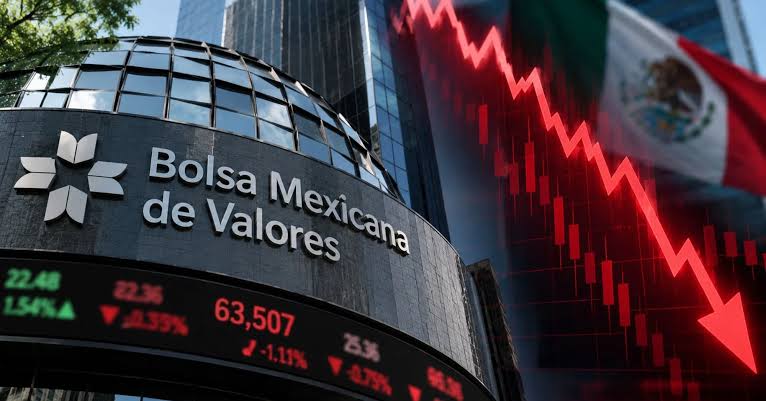
Mexican equities ended Friday lower for a sixth consecutive session, completing a sustained pullback after recent records. The S&P/BMV IPC closed down 0.12% at 68,629.46 points, while the FTSE BIVA fell 0.07% to 1,399.46. These are official closing moves for November 20, not intraday snapshots, and they capture a modest final-day decline within a larger correction.
The losing sequence began after the main benchmark reached new highs on Wednesday, November 11. Across the six sessions, the S&P/BMV IPC accumulated a 4.70% decline and moved to a 1.65% loss for November. A small daily percentage can therefore be misleading when viewed alone: the relevant market signal is the compounding of repeated negative closes from an elevated starting point.
Weak sentiment in foreign markets, particularly concern about technology shares, provided the broad external backdrop. That relationship is directional rather than mechanical. Mexico’s benchmark has a different sector composition from United States technology-heavy indices, and local currency moves, rates, company news and positioning can amplify or offset pressure imported from global markets.
The session was not a uniform sell-off. Industrias Peñoles declined 1.75% to 641.95 pesos and airport operator GAP lost 1.73% to 423.21 pesos. By contrast, food producer Gruma rose 5.15% to 288.91 pesos. Those moves show substantial security-level dispersion even while both broad indices finished slightly lower.
Market analyst José Antonio Rivera’s closing tally therefore supports two simultaneous readings. Index momentum deteriorated over six days, but investors continued to distinguish among business models and earnings exposures. Gruma’s gain did not reverse the benchmark decline, just as the losses in Peñoles and GAP should not be extrapolated to every listed company.
The pullback also follows a record-setting phase, so the 4.70% figure measures distance from a recent high rather than a long-term bear market by itself. Price declines can reflect profit-taking, valuation adjustment or risk reduction without proving a recession or permanent impairment. Confirming a broader regime change would require duration, volume, breadth and deterioration in earnings expectations.
For portfolio interpretation, closing levels and time horizons matter. The index’s 1.65% monthly decline is smaller than the six-session loss because earlier November gains offset part of the retreat. The two percentages use different starting dates and are both valid. Confusing them would overstate either the monthly damage or the scale of the latest sequence.
The next evidence will be whether the benchmark stabilises, market breadth improves and foreign technology anxiety recedes, alongside domestic rate, currency and corporate signals. One positive session would end the consecutive-close count but not automatically repair the drawdown. Conversely, a seventh decline would extend momentum without proving that every sector shares the same fundamental problem.