
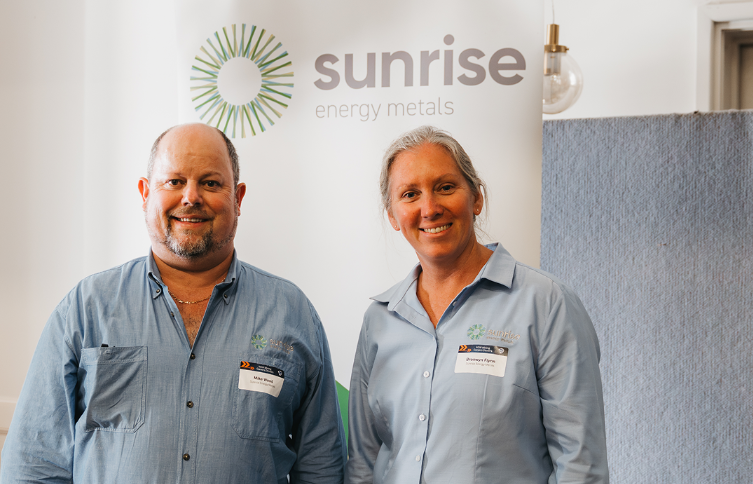
The U.S. Department of War's Office of Strategic Capital has signed a conditional commitment to lend Sunrise Energy Metals as much as $400 million for the Syerston Scandium Project in New South Wales. The amount is equivalent to roughly A$560 million, but it is not yet a disbursed investment or an unconditional financing agreement.
Syerston sits near Fifield in central-western New South Wales, about 350 kilometres west-north-west of Sydney. Sunrise aims to build what it describes as the world's first primary source of mineable, high-grade scandium, with initial capacity of 60 tonnes of scandium oxide a year and production targeted for the first half of 2028.
The supply case rests on an unusually concentrated market. Scandium is currently recovered mainly as a by-product of other industrial or mineral operations, and no primary mine-source supply operates globally. U.S. officials estimate foreign competitors account for about 80% of mined production and nearly all processing; the United States has not mined scandium since 1969.
The proposed funding is intended to support more than extraction. Alongside private capital, it would finance a chain extending from Syerston's mine to metallisation and additive manufacturing capacity aligned with U.S. industry. The broader public-private transaction has been described as approaching $1 billion, and the Department would receive a right of first offer on Sunrise's output.
That strategic structure does not remove execution conditions. Sunrise must still satisfy financial, legal, technical and other requirements before financial close. Until those tests are completed, the $400 million remains a conditional loan commitment; construction, disbursement and the planned 2028 production date should not be treated as completed or guaranteed.
The project already has a potential industrial route to market. Sunrise signed a five-year arrangement with Lockheed Martin allowing the U.S. defence contractor to buy up to 15 tonnes of scandium oxide from Syerston. The option supports demand visibility, but it is a ceiling on possible purchases rather than proof that the full quantity will be taken.
Washington presented Syerston within a wider $3 billion package of critical-mineral and battery investments. Australian Resources Minister Madeleine King described the commitment as confidence in Australia's capacity to supply partners, while the financing also advances the bilateral effort to build supply chains outside the countries that dominate current production and processing.
The decisive milestones now sit between political announcement and physical output: completion of due diligence, satisfaction of loan conditions, financial close, construction and commissioning. If those stages proceed, Syerston would test whether state-backed finance can turn a large Australian resource into a primary scandium supply chain rather than another strategically important deposit awaiting development.